I hate chicken that’s dry and rubbery. But my chicken always seemed to turn out that way, especially when cooking chicken breasts. Until I learned this.
When you search online for the best temperature to cook chicken, most websites, people and AI will tell us that we should cook our chicken to 165°F or 74°C. And they are not wrong. It is the temperature that eliminates all the bacteria in the chicken. But there’s another way to look at this.
The Science Behind Chicken Cook Temperature and Time:
If we cook chicken at a lower temperature, it will be juicier and more succulent, but it won’t be safe to eat, but if we cook it too hot, it becomes dry and tough. What matters is that bacteria are eliminated by both temperature and time. If we cook chicken at a lower temperature for longer time, it’ll be just as safe.
It’s true that bacteria cannot survive at 165°F or 73.8°C. At 165°F, bacteria are killed instantly, within a second. But to get to 165°F, we need to get our chicken to 140°F, 150°F and 160°F first.
On the other hand, if we cook chicken at 160°F/71°C for 15 seconds, bacteria cannot survive that temperature either. This means that after 15 seconds, the chicken is just as safe—but much juicier. The same applies if you cook the chicken for 48 seconds at 155°F/68.3°C or for around 2 minutes and 48 seconds at 150°F/65.5°C.
(This is only for chicken breasts. Chicken thighs have collagen in them that melts while cooking and creates a better texture and richer flavor. But collagen melts at higher temperatures, at around 175°F-195°F. So, thighs should be cooked to that temperature. Ground poultry meat is also an exception to this. It must be cooked to 164°F/74°C.)
Salmonella and Other Foodborne Diseases:
Salmonella is common in poultry and is the main reason undercooked chicken can be dangerous. It can cause fever, diarrhea, and stomach cramps, and it’s only eliminated through proper cooking. Other bacteria like Campylobacter and E. coli can survive if the chicken is undercooked. So, chicken needs to be cooked with both temperature and time in mind to be safe.
It can spread through cross contamination too. This can happen if you wash chicken in your sink where you wash your dishes and don’t properly sanitize it. That’s why washing chicken isn’t recommended, proper cooking is what kills harmful bacteria. And it can also spread through the cutting board or knife you used to cut your chicken. So, make sure to properly sanitize your cutting board and knife which you use to cut chicken before using it for cutting anything else.
How Higher Temperature and Cooking Time Helps Us defeat these Bacteria:
According to the USDA, chicken should be cooked to 165°F/74°C. This is where instant pasteurization happens, meaning that the chicken becomes safe to eat with 7-log reduction. 7-log reduction means that 99.99999% reduction in the number of microorganisms, meaning only 1 in 10 million survives.
It is the standard practice in cooking, and 7-log reduction can instantly be achieved at 165°F/74°C, but this can be achieved by both temperature and cooking time as discussed above.
Chicken Breast Pasteurization Temperature Chart:
| Temperature | Time Required to Be Safe |
|---|---|
|
165°F |
Instant |
|
160°F |
15 seconds |
|
155°F |
50 seconds |
|
150°F |
2 min 48 sec |
How I Determined the Best Temperature to Cook Chicken Breasts (The Experiment):
Now to find the best temperature and time to cook chicken breasts at, I decided to conduct a little experiment. I cooked 4 chicken breasts at different temperatures to see which temperature provides the best results in terms of juiciness and texture.
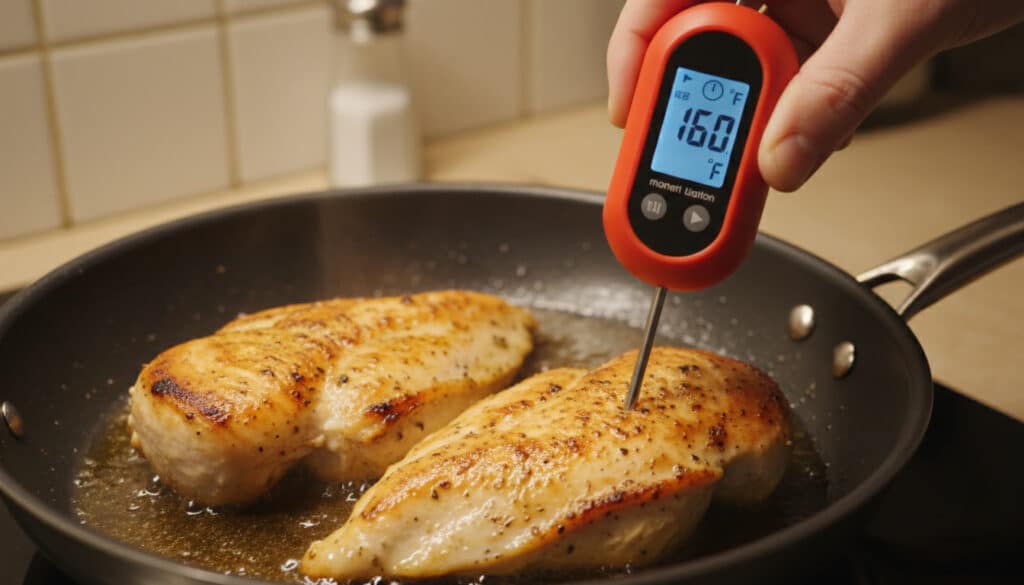
I stuck wireless meat thermometer probes in 4 different chicken breasts to track their temperature and seared them on a pan. For this experiment I cooked the first chicken to 150°F and maintained that temperature for about 3 minutes. The second chicken breast was brought up to 155°F for 50 seconds, the third to 160°F for 15 seconds. And the last one I heated to 165°F and just as it hit 165°F I took it off the pan.
Let’s talk about the one cooked at 165°F/74°C according to USDA recommendations. I took it off just as the reading showed 165 internal at the thickest part of the breast. Keep in mind that the chicken still cooks for a little while as its temperature rises even after taking it off the heat. I can confidently say that this was the driest chicken out of all 4. With a woody texture and white meat, all the juices were pushed out of the chicken leaving it dry and chewy.
The chicken breast I cooked at 160°F and after the thermometer showed 160°F I maintained the temperature there for exactly 15 seconds and instantly killed the heat after the time was up. This one was a little bit better than the one cooked at 165°F. Just a tad bit juicier and not as chewy but there wasn’t that big a difference.
Things really started to change when I cooked the third chicken breast for 50 at 155°F. Compared to the one cooked at 165°F, there were noticeable differences. The chicken was much more tender and not dry at all. There was a big difference in texture too.
The real game changer was the fourth chicken breast that I cooked at 150°F for 3 minutes. Tried my best to maintain the temperature at 150°F for 3 minutes by adjusting the heat during the sear. And the result was a chicken breast with a slightly pinkish center but completely safe to eat. The difference was clear between this one and the one cooked at 165°F. It was tender, juicier and the texture was way better. It did not feel rubbery or hard to chew at all. And this is my preferred temperature to cook chicken breasts at.
Final Verdict:
Chicken breast is not a bad cut of meat. But the way we cook it is wrong. The temperature we cook it at and for how long we cook it for determines everything. A lot of people say that they prefer chicken legs or thighs over chicken breasts but there are some recipes that only work with chicken breasts.
So, the next time you cook chicken, don’t just aim for 165°F. Think about temperature and time together. That’s the difference between chicken that’s just safe, and chicken that’s actually juicy, tender, and worth eating.